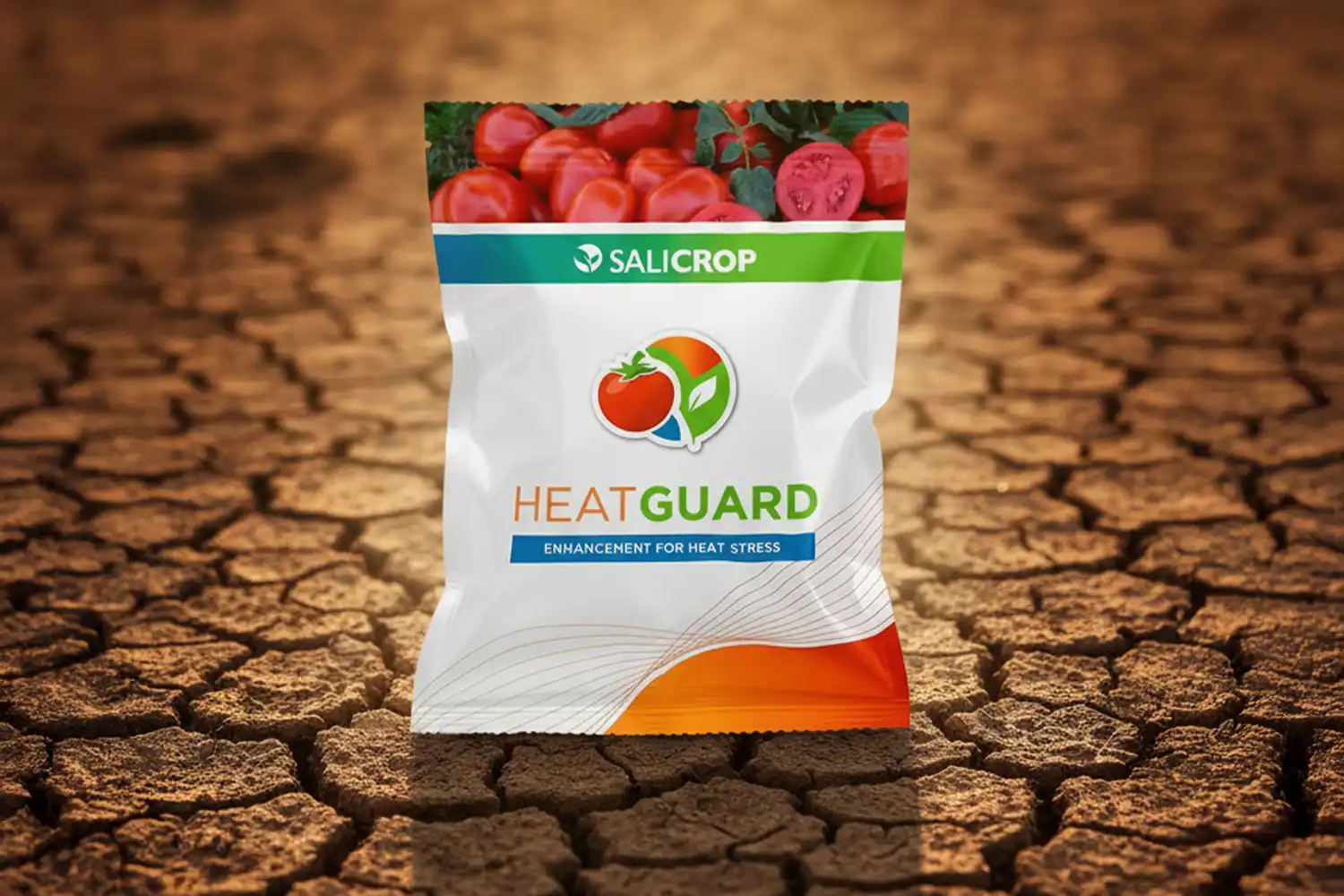
Short answer: the Climate Resilience, Desertification and Applied Innovation Report, launched during Climate Week NYC in September 2026 by the Israel Innovation Authority and C4IR Israel, features SaliCrop as a Solution Snapshot for climate-resilient agriculture. The report highlights SaliCrop's non-GMO seed enhancement as a way to keep crops productive under heat, drought and salinity, without changing the variety or farming practices.
A national report on desertification
The report was led by the Israel Innovation Authority and C4IR Israel, part of the World Economic Forum's Centre for the Fourth Industrial Revolution network. Contributors include DeserTech, Ben-Gurion University's National Institute for Climate and Environmental Policy, the Jacob Blaustein Institutes for Desert Research, the Stanford Doerr School of Sustainability, C4IR India, C4IR Azerbaijan, Nura Global Innovation Lab, the Jewish Climate Trust and the Evergreen Innovation Platform.
Desertification today affects more than 170 countries and directly impacts about 250 million people. The report treats it as a systemic resilience challenge for water, food, soil and energy, and uses Israel and the Negev as a reference model for applied climate innovation.
Five technology areas for drylands
- Water systems: reuse, desalination, smart irrigation and digital water management.
- Climate-resilient agriculture: keeping crops productive under heat, drought and salinity.
- Soil and land restoration: rebuilding soil health before degradation becomes irreversible.
- Environmental intelligence: sensing, AI and decision support for earlier action.
- Renewable and distributed energy: powering water and food systems in arid regions.
A mapping exercise for the report identified about 100 Israeli companies in data, sensing, AI and decision support for desertification resilience, against roughly 900 globally in adjacent fields. The report also places Israel among the countries that combine a high density of climate-resilience startups with strong capital investment per capita.
SaliCrop in the agriculture chapter
In its chapter on the agriculture-desertification nexus, the report presents SaliCrop's seed enhancement platform, which activates multiple natural stress-response mechanisms in the plant before planting. Each protocol is adapted to specific crop varieties and stress conditions, improving crop establishment, stability and yield under abiotic stress.
The report notes validation through more than 250 field and commercial projects across 12 countries, including tomato production in Mediterranean regions exposed to recurring heat stress and field programs in saline environments. It frames this type of solution as supporting both food security and the productive use and rehabilitation of land affected by salinity, heat and drought.
Published commercial results include:
- Extremadura, Spain, 2025: up to 22% more yield in processing tomato (106.8 vs 87.4 t/ha). Read the case study.
- Portugal, with Sugal: about 57% more yield (69 vs 44 t/ha) in a season hit by heat, waterlogging and salinity. Read the case study.
Technology is not enough
The report's central argument is that innovation alone will not scale. Solutions reach the field when four enablers are in place: supportive policy, accessible finance, skilled talent and international collaboration. It calls for real-world validation environments and for financing the full deep-tech pathway, from R&D to first commercial deployment.
The Negev as a living lab
DeserTech authored Chapter 4.1, which presents Israel and the Negev as a living lab where dryland solutions are tested under heat, drought and salinity before going global. The report also features Groundwork BioAg as an example of mycorrhizal solutions for drought-resilient agriculture.
To explore seed enhancement for your varieties, contact contact@salicrop.com.