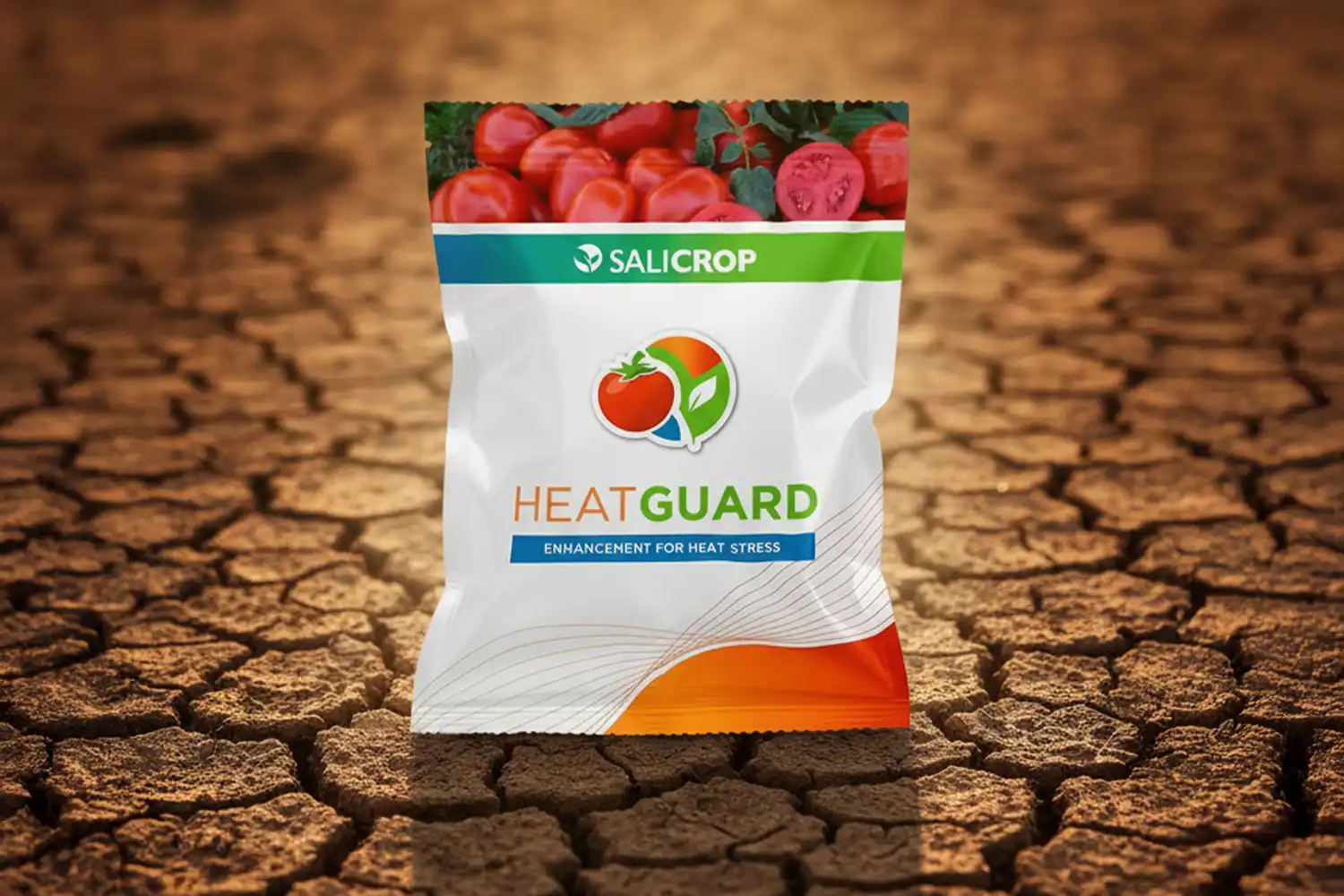
Short answer: there are three ways to give a crop more tolerance to heat, drought and salinity. You can breed it, edit its genes, or enhance the seed before planting. Breeding and gene editing change the variety. Seed enhancement keeps the variety exactly as it is and adds a resilience layer through a one-time, pre-planting treatment. For seed companies that need climate resilience this season, on varieties they already sell, seed enhancement is the fastest route to market.
Why climate change is now a seed problem
Heat waves during flowering, warm nights above 21°C, saline irrigation water and longer dry spells are no longer edge cases. In processing tomato, for example, a single heat wave during fruit set can cost a grower a large share of the season, and the processor receives lower and less predictable volumes and quality. Growers respond with more water, more inputs and later planting, but these measures act after the stress has begun. The seed is the one input every field starts with, which makes it the most scalable place to build resilience.
Path 1: Breeding for climate tolerance
- What it is: selecting and crossing parent lines to develop new varieties that tolerate heat, drought or salinity.
- Strengths: durable, inherited traits; well understood by the industry.
- Limits: a new variety typically takes many years to develop and register, and each crop and market needs its own program. Tolerance to one stress can come at the expense of yield or quality traits.
- Best for: long-term portfolio strategy.
Path 2: Gene editing and genetic modification
- What it is: changing specific genes to improve stress tolerance.
- Strengths: precise and potentially fast at the lab stage.
- Limits: regulatory status differs by country, and many processors, retailers and consumers in Europe and other markets still require non-GMO supply chains.
- Best for: markets and crops where regulation and buyers allow it.
Path 3: Seed enhancement (advanced seed priming)
- What it is: a controlled pre-planting treatment that conditions the seed's own stress-response mechanisms, so the plant responds faster and stronger when heat, salinity or drought arrive.
- Strengths: works on existing commercial varieties; no change to genetics, no residue, and no change to how growers sow, irrigate or manage the crop.
- Limits: protocols must be calibrated for each crop and variety, and results depend on stress pressure in the field.
- Best for: seed companies and processors that need climate resilience now, in non-GMO supply chains.
How the three paths compare
- Time to market: breeding, years; gene editing, years plus regulation; seed enhancement, a calibration in the lab (typically 6 to 10 weeks) followed by field projects.
- Effect on the variety: breeding and editing create a new variety; seed enhancement keeps the original variety identity and registration.
- Regulatory path: GMO and gene-editing rules vary by country; seed enhancement is a seed-priming-class process with no genetic change.
- Fit with existing portfolios: seed enhancement can be applied to varieties a seed company already sells, creating a premium climate-resilient version.
The three paths are not mutually exclusive. A seed company can breed for long-term tolerance and use seed enhancement to protect performance in today's varieties while the breeding program matures.
What seed enhancement delivers in the field
SaliCrop's non-GMO seed enhancement has been tested in more than 250 projects across over 12 countries. Published results from commercial processing tomato fields include:
- Extremadura, Spain, 2025: up to 22% more yield (106.8 vs 87.4 t/ha), 13.6% to 25% more lycopene and 43% fewer rotten fruits, with Brix, color and pH within factory specifications. Read the case study.
- Portugal, with Sugal: 69 vs 44 t/ha in a season hit by heat, waterlogging and salinity, about 57% more yield, with industrial quality kept within specification. Read the case study.
How a seed company can start
- Calibration: SaliCrop calibrates a protocol for your variety in its lab.
- Proof of concept: about one hectare on partner land, with an untreated control.
- Pre-commercial: up to about 10 hectares across several locations.
- Commercial: per-hectare treatment service or a licensing agreement.
Frequently asked questions
What are climate-resilient seeds?
Seeds that help a crop maintain yield and quality under climate stress such as heat, drought and salinity. Resilience can come from breeding, from gene editing, or from seed enhancement applied to existing varieties.
Is seed enhancement the same as GMO?
No. Seed enhancement does not change the crop's DNA. It conditions the seed's natural stress-response processes before planting and leaves no residue.
Does seed enhancement replace breeding?
No. It complements breeding. Breeding builds long-term genetic tolerance; seed enhancement adds resilience to the varieties already on the market.
Which crops can be enhanced?
SaliCrop's commercial focus is vegetables: processing tomato, onion and pepper are in commercial use, and lettuce is in development. The platform is variety-agnostic, so protocols can be calibrated for a seed company's existing varieties.
To explore a calibration project for your varieties, contact contact@salicrop.com.