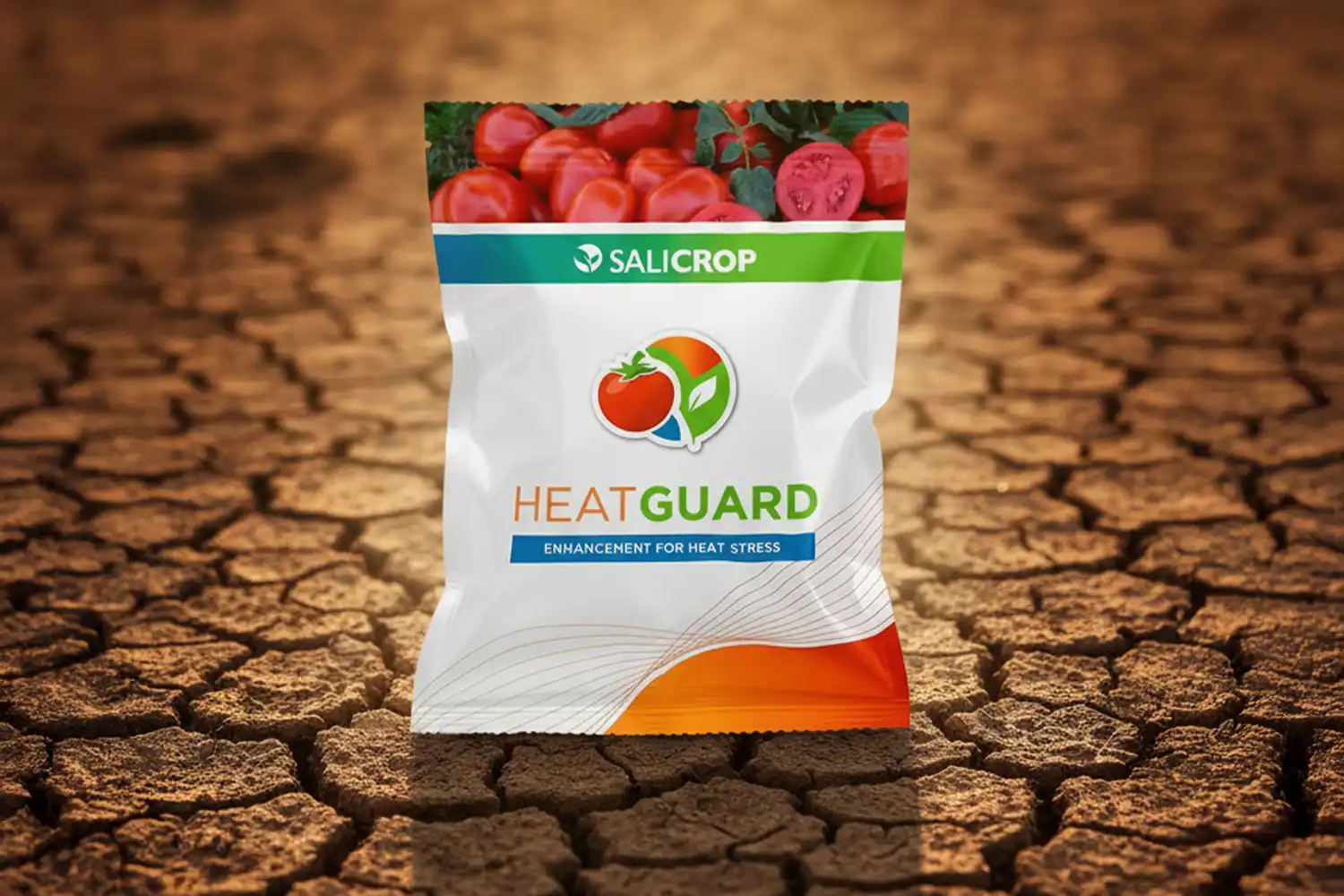
Short answer: conventional seed priming is designed to make seeds germinate faster and more uniformly. Seed enhancement, as developed by SaliCrop, is an advanced form of priming designed for a different goal: helping the plant withstand heat, salinity and drought through the season. Both are pre-planting, non-GMO seed treatments. The difference is what they are calibrated to do, and how long the effect lasts in the field.
What conventional seed priming does
Seed priming is a pre-sowing technique in which seeds are partially hydrated so that early germination processes begin, then dried back for normal handling. Common methods include hydropriming, osmopriming and matrix priming. The seed industry has used priming commercially for decades, especially in vegetables, to achieve:
- faster germination and emergence
- more uniform stands and transplants
- better germination at sub-optimal temperatures
Where conventional priming reaches its limits
- Extreme heat: performance tends to decline at high temperatures, for example lettuce thermodormancy above 30°C.
- Season-long stress: priming mainly improves the start of the crop. Heat waves at flowering, warm nights or saline irrigation water later in the season are outside its design goal.
- Storage: primed seed can lose longevity if storage conditions are not well controlled.
What seed enhancement adds
SaliCrop's seed enhancement belongs to the same seed-priming class of treatments: it is applied before planting, involves no genetic modification and leaves no residue. What changes is the protocol. Each treatment is calibrated for a specific crop and variety and exposes the seed to controlled abiotic stressors, conditioning the plant's natural stress-response pathways, including osmotic balance, hormone signaling and antioxidant protection. The aim is a plant that responds faster and stronger when real stress arrives, not only a faster start.
- Target: tolerance to heat, salinity and drought, from germination through fruit set.
- One process: a SaliCrop treatment replaces standard priming, so the seed needs only one pre-planting step.
- Same variety: genetics, variety identity and registration stay with the seed company.
- Same farm practice: growers sow, irrigate and manage the crop as usual.
Side by side
- Main goal: priming, germination speed and uniformity; seed enhancement, yield and quality under climate stress.
- When the effect matters: priming, emergence; seed enhancement, emergence and the stress windows that follow, such as flowering and fruit set.
- Calibration: priming, per crop or seed lot; seed enhancement, per crop and variety, against the stress profile of the target market.
- Measured outcome: priming, germination tests; seed enhancement, yield, quality and losses in commercial fields with untreated controls.
Where are the results?
Seed enhancement is judged in the field, not only in a germination test. In the 2025 processing tomato season in Extremadura, Spain, SaliCrop-treated commercial plots delivered up to 22% more yield (106.8 vs 87.4 t/ha), 13.6% to 25% more lycopene and 43% fewer rotten fruits, with factory quality parameters within specification. Read the case study. For a broader comparison with breeding and gene editing, see Climate-Resilient Seeds: Breeding, Gene Editing or Seed Enhancement?
And biostimulant seed treatments?
Biostimulant seed treatments, often based on seaweed or other biological extracts, are applied as a coating and also aim to trigger stress-response processes. They are typically combined with fungicide and insecticide treatments on standard treatment lines. Seed enhancement differs in that the conditioning happens inside the seed during a controlled process before any coating, and the protocol is calibrated per variety.
Frequently asked questions
Is seed enhancement a type of seed priming?
Yes. It is an advanced, seed-priming-class process. It differs from conventional priming in its goal, season-long tolerance to heat, salinity and drought, and in its variety-specific calibration.
Can enhanced seed also be primed or coated?
A SaliCrop treatment replaces standard priming. The treated seed can then go through the seed company's usual coating, packaging and logistics.
Does seed enhancement need regulatory approval?
It involves no genetic modification and leaves no residue, so it does not require GMO approval or crop-protection product registration in the markets where SaliCrop operates.
Which crops benefit most?
High-value vegetables with high exposure to heat or salinity, such as processing tomato, pepper, onion and lettuce.
To compare your current priming with a SaliCrop protocol, contact contact@salicrop.com.